Generative AI for Visual Creators: A Practical Guide to Working Faster, Creating Better, and Staying in Control
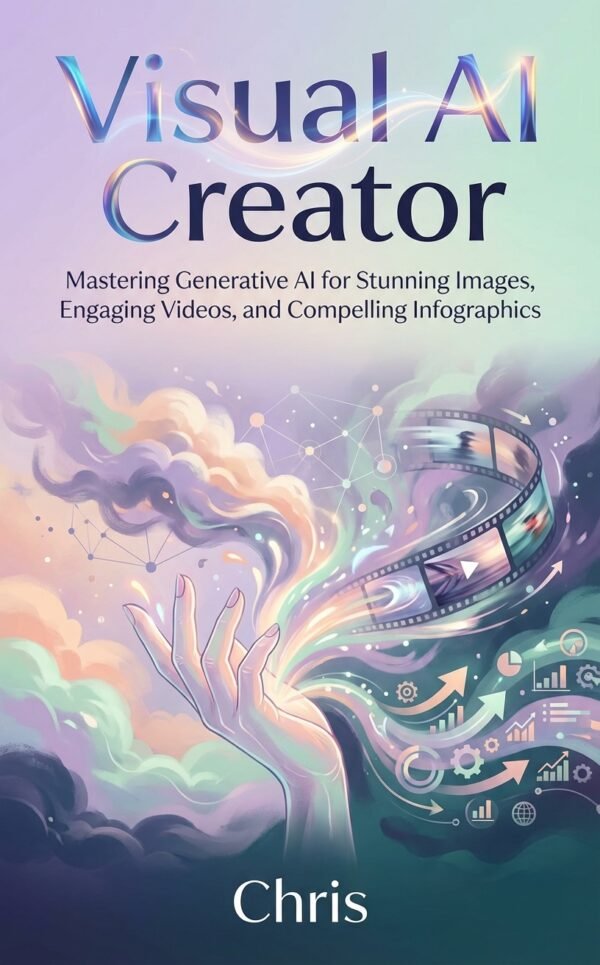
There is a version of AI education that is aimed at developers, researchers, and people who want to understand machine learning at a technical level. This is not that. Visual AI Creator is written for graphic designers, video producers, social media managers, content creators, and marketers — people who work in visuals professionally and want to know exactly how to use generative AI tools to produce better work in less time, without the technical overwhelm.
The book covers three core output types — images, videos, and infographics — and treats each one seriously. Not as an afterthought. Not as a couple of pages with a list of tool names. As a proper, substantive guide with the depth required to actually change how you work.
Why This Is Different From What You Have Already Read About AI
Most content about AI for creatives falls into one of two failure modes. Either it is a surface-level introduction that tells you generative AI is exciting without explaining how to use it — or it is a technology-focused deep dive that has little relevance to the day-to-day reality of someone producing content for clients or an audience.
Visual AI Creator is neither. It opens with a clear explanation of how generative models actually work — GANs, diffusion models, the mechanics of prompting — explained not for its own sake but because understanding how these systems think makes you significantly better at directing them. The difference between a mediocre AI output and a genuinely useful one is almost always in the quality of the prompt, and prompt engineering is treated as a skill in this book rather than an afterthought.
From there, the book moves into the practical application of these tools across specific creative disciplines. Image generation and refinement, including upscaling, style transfer, and advanced editing. Video scripting, storyboarding, AI-assisted editing, motion graphics, and automated production techniques. Infographic design, data visualisation, and making complex information accessible and visually compelling.
Tools Covered, Workflows Built
Rather than pointing vaguely at the existence of AI tools and leaving you to figure out the rest, this book gives you an in-depth review and comparison of the leading platforms — Midjourney, Stable Diffusion, RunwayML, and others — with specific guidance on which tools are best suited to which tasks and how to integrate them into a production workflow without disrupting what already works.
The workflow chapter is particularly practical. Building an AI pipeline for visual content production is not just about knowing which tools exist — it is about connecting them in a sequence that saves time at scale. Batch creation, asset management, template building, and the systematic approach to content production that distinguishes a professional operation from an enthusiast experimenting with new software.
The Parts Most AI Books Skip
There are two areas that separate this book from most others in the space. The first is the chapter on visual SEO, accessibility, and cross-platform distribution — applying AI not just to the creation of visuals but to their performance. Image optimisation, alt text generation, platform-specific formatting, and how AI tools can be used to adapt content for different audiences and contexts.
The second is the chapter on ethics, copyright, and responsible use. This is not a legal disclaimer buried at the back. It is a substantive treatment of the questions every working creative using AI will eventually face: what you can and cannot commercially own from AI-generated output, how to ensure sufficient human authorship, how to avoid perpetuating bias through your prompts, and how to use these tools in a way that builds rather than damages your professional reputation.
Who Needs This Book
If you are already working in a visual creative discipline and losing hours to tasks that AI could handle faster without sacrificing quality, this book gives you the knowledge to change that immediately. If you are newer to professional visual content creation and want to build modern workflows from the start rather than learning legacy habits first, the foundational chapters give you exactly the context you need.
The common thread is that this book treats you as a working professional, not a beginner in need of inspiration. The tone is direct, the examples are practical, and the expectation throughout is that you will implement what you read — not just feel good about having learned it.