Create Stunning Visuals Faster Without Sacrificing Your Creative Edge
- Master prompt engineering to get professional-quality AI image results every time
- Build AI-assisted video workflows that cut production time without cutting quality
- Turn complex data into compelling infographics using generative AI tools
- Get an honest, in-depth comparison of leading platforms — Midjourney, Stable Diffusion, RunwayML, and more
- Understand AI copyright and ethics so you can use these tools confidently in commercial work
$27.00 Original price was: $27.00.$17.00Current price is: $17.00.
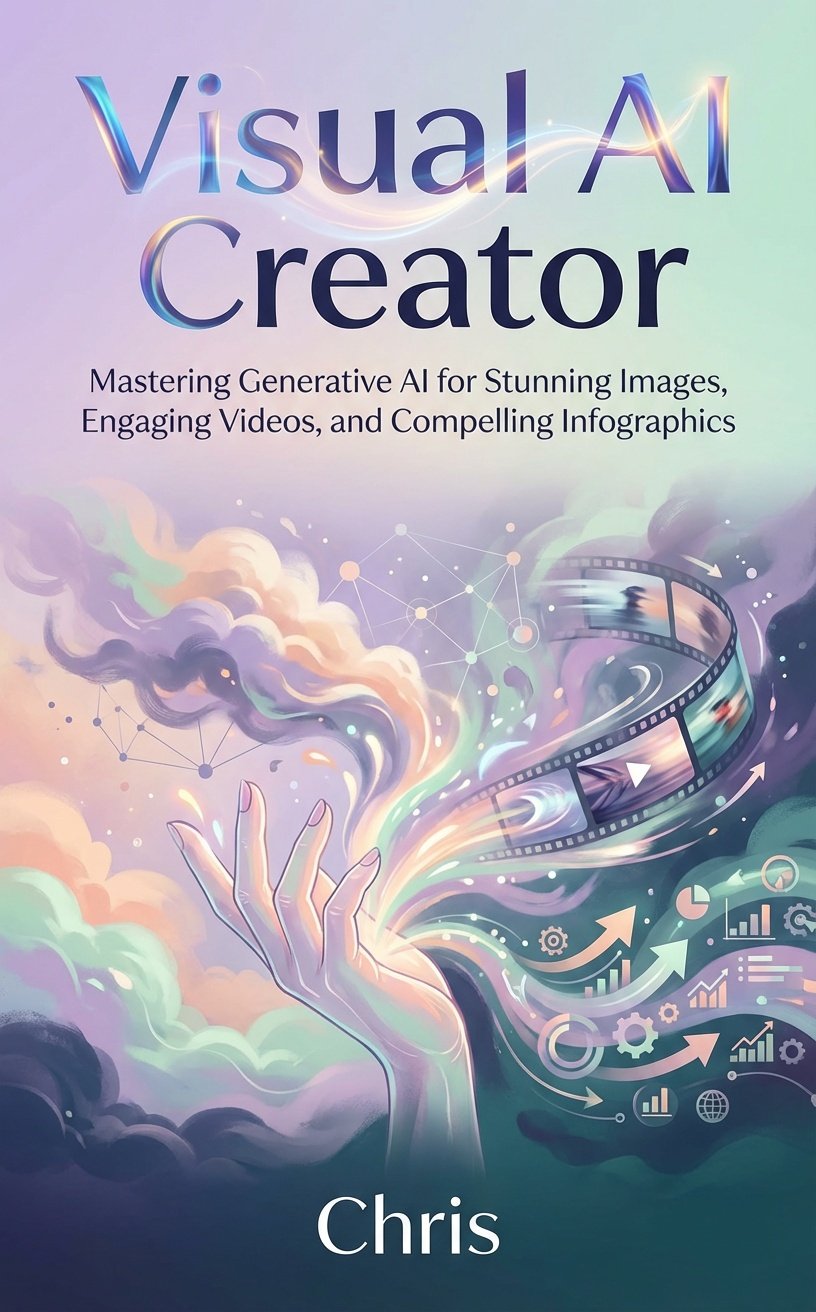
A hands-on guide for graphic designers, video creators, and content professionals ready to use generative AI in their work. Covers prompt engineering, AI video production, infographic design, platform comparisons, workflow integration, and commercial copyright. Practical, jargon-free, and immediately applicable. Instant PDF download.
Benefits
- Produce more visual content in less time without hiring additional team members or compromising on quality
- Stop relying on expensive stock imagery by generating unique, on-brand visuals for every project
- Reduce creative block by using AI to rapidly generate concepts and iterations for client review
- Stay commercially protected by understanding exactly what you can and cannot own from AI-generated output
- Build integrated AI pipelines that make your entire visual content production process more efficient and scalable
- Future-proof your creative skillset by mastering the tools that are already reshaping the visual content industry
What You Will Learn
- How generative AI models actually work — GANs, diffusion models, and the mechanics behind the tools you use every day
- How to write detailed, effective prompts that produce professional-quality images consistently
- Advanced image techniques including upscaling, style transfer, inpainting, and outpainting
- How to use AI for video scripting, storyboarding, automated editing, motion graphics, and visual effects
- How to generate compelling infographics and data visualisations using AI tools
- Which AI platforms to use for which tasks — with an honest, in-depth comparison of the leading tools
- How to build a seamless AI content production pipeline that integrates with your existing workflow
- How to optimise AI-generated visuals for SEO, accessibility, and cross-platform distribution
- The legal and ethical framework for commercial use of AI-generated visuals — copyright, authorship, bias, and transparency
Who This Is For
- Graphic designers who want to produce more concepts, iterations, and final assets in less time
- Video creators and editors looking to speed up production without sacrificing storytelling quality
- Social media managers and content marketers who need a consistent supply of high-quality, scroll-stopping visuals
- Freelancers and agency creatives who want to expand their service offering without expanding their hours
- Marketers and brand managers who commission visual content and want to understand what AI can realistically deliver
- Anyone already experimenting with AI image tools who wants to move beyond basic prompting and build a proper professional workflow
Results
- A working understanding of generative AI that lets you choose the right tool for every visual task with confidence
- A prompt engineering skillset that consistently produces high-quality, usable AI image outputs
- A documented AI production workflow for images, video, and infographics you can begin using immediately
- A clear framework for commercial use of AI visuals — what you own, how to protect it, and how to stay on the right side of copyright
- A significant reduction in the time spent on repetitive visual production tasks, freeing up creative capacity for higher-value work
- A competitive advantage in your field by mastering tools that most creators are still using inefficiently or not at all
Offer Stack
About
Generative AI for Visual Creators: A Practical Guide to Working Faster, Creating Better, and Staying in Control
There is a version of AI education that is aimed at developers, researchers, and people who want to understand machine learning at a technical level. This is not that. Visual AI Creator is written for graphic designers, video producers, social media managers, content creators, and marketers — people who work in visuals professionally and want to know exactly how to use generative AI tools to produce better work in less time, without the technical overwhelm.
The book covers three core output types — images, videos, and infographics — and treats each one seriously. Not as an afterthought. Not as a couple of pages with a list of tool names. As a proper, substantive guide with the depth required to actually change how you work.
Why This Is Different From What You Have Already Read About AI
Most content about AI for creatives falls into one of two failure modes. Either it is a surface-level introduction that tells you generative AI is exciting without explaining how to use it — or it is a technology-focused deep dive that has little relevance to the day-to-day reality of someone producing content for clients or an audience.
Visual AI Creator is neither. It opens with a clear explanation of how generative models actually work — GANs, diffusion models, the mechanics of prompting — explained not for its own sake but because understanding how these systems think makes you significantly better at directing them. The difference between a mediocre AI output and a genuinely useful one is almost always in the quality of the prompt, and prompt engineering is treated as a skill in this book rather than an afterthought.
From there, the book moves into the practical application of these tools across specific creative disciplines. Image generation and refinement, including upscaling, style transfer, and advanced editing. Video scripting, storyboarding, AI-assisted editing, motion graphics, and automated production techniques. Infographic design, data visualisation, and making complex information accessible and visually compelling.
Tools Covered, Workflows Built
Rather than pointing vaguely at the existence of AI tools and leaving you to figure out the rest, this book gives you an in-depth review and comparison of the leading platforms — Midjourney, Stable Diffusion, RunwayML, and others — with specific guidance on which tools are best suited to which tasks and how to integrate them into a production workflow without disrupting what already works.
The workflow chapter is particularly practical. Building an AI pipeline for visual content production is not just about knowing which tools exist — it is about connecting them in a sequence that saves time at scale. Batch creation, asset management, template building, and the systematic approach to content production that distinguishes a professional operation from an enthusiast experimenting with new software.
The Parts Most AI Books Skip
There are two areas that separate this book from most others in the space. The first is the chapter on visual SEO, accessibility, and cross-platform distribution — applying AI not just to the creation of visuals but to their performance. Image optimisation, alt text generation, platform-specific formatting, and how AI tools can be used to adapt content for different audiences and contexts.
The second is the chapter on ethics, copyright, and responsible use. This is not a legal disclaimer buried at the back. It is a substantive treatment of the questions every working creative using AI will eventually face: what you can and cannot commercially own from AI-generated output, how to ensure sufficient human authorship, how to avoid perpetuating bias through your prompts, and how to use these tools in a way that builds rather than damages your professional reputation.
Who Needs This Book
If you are already working in a visual creative discipline and losing hours to tasks that AI could handle faster without sacrificing quality, this book gives you the knowledge to change that immediately. If you are newer to professional visual content creation and want to build modern workflows from the start rather than learning legacy habits first, the foundational chapters give you exactly the context you need.
The common thread is that this book treats you as a working professional, not a beginner in need of inspiration. The tone is direct, the examples are practical, and the expectation throughout is that you will implement what you read — not just feel good about having learned it.
$27.00 Original price was: $27.00.$17.00Current price is: $17.00.
Product Details
- Difficulty: Intermediate — written for working creatives with some existing design, video, or content production experience; beginners will benefit from the foundational chapters but will get the most value once they have started experimenting with AI tools
- Time to Complete: 4–6 hours reading time; tool integration and workflow implementation is ongoing and builds naturally into existing creative projects
- Equipment Needed: PDF reader on any device; to apply the techniques you will need access to at least one generative AI platform — many referenced tools (Midjourney, Stable Diffusion, RunwayML) have free tiers or trial access
- Income Potential: High — creatives using AI tools to increase output capacity and expand service offerings report significant increases in monthly revenue; freelancers can realistically add $500–$3,000+ per month through increased capacity and new service lines
- Monetization Method: Freelance services, content creation, digital products, agency work, social media management, and client visual production
- Format: PDF eBook, instant download
Frequently answered questions
Do I need to be technical or understand coding to use this book?
Not at all. The book explains how generative AI works in plain language — enough to make you a better prompt engineer and tool user, not enough to make your eyes glaze over. No coding, no technical background required.
Which AI tools does the book cover?
The book includes an in-depth review and comparison of leading visual AI platforms including Midjourney, Stable Diffusion, and RunwayML, along with guidance on which tools are best suited to specific creative tasks — images, video, and infographics.
Is this useful if I have already been experimenting with AI image tools?
Yes, and this is probably the audience that gets the most from it. If you have been using tools like Midjourney at a basic level but want to move into advanced prompting, workflow integration, video production, and infographic design — this book takes you to the next level.
Can I use AI-generated visuals for commercial client work?
The book has a dedicated chapter on this exact question — covering copyright, commercial use, human authorship requirements, and platform terms of service. It gives you the framework to use AI commercially with clarity, rather than vague anxiety.
Does the book cover video as well as images?
Yes. Two full chapters are dedicated to video — one covering AI for scripting, storyboarding, and asset creation, and one covering motion graphics, automated editing, and visual effects. Video is treated with the same depth as image generation, not as a footnote.
How do I access the eBook after purchase?
Instantly. Once your payment is confirmed, a download link is sent to your email and available in your account. The PDF opens on any device — phone, tablet, or computer.
Download Your Copy and Start Creating Smarter Visuals Today
$27.00 Original price was: $27.00.$17.00Current price is: $17.00.
Delivery
You will receive delivery straight after purchase
Additional information
| Access Type | |
|---|---|
| Complexity | |
| Format | |
| Goal | |
| Income Type | |
| Level | |
| Monetization Method | |
| Niche | |
| Time Commitment |
You may also like…
Related products
-
Sale!

Mindful Sleep – Techniques and Interactive Exercises for Better Rest
$29.00Original price was: $29.00.$19.00Current price is: $19.00. Add to cart -
Sale!

Mind-Body Workout for Mental Serenity – An Illustrated Workbook for Anxiety, Depression, and Stress Relief Through Movement and Mindfulness
$20.00Original price was: $20.00.$16.00Current price is: $16.00. Add to cart -

The Portable Professional – Guide to Freelancing, Traveling, and Thriving as a Digital Nomad
$29.99 Add to cart -
Sale!

Bootstrapped Riches – From 9-5 Burnout to Micro-Business Master. Launch Your Debt-Free Empire
$29.99Original price was: $29.99.$19.99Current price is: $19.99. Add to cart